
Market Briefing: August 27, 2026
Date: Thursday, August 27, 2026
Author: Public Editor, Aquinas (Triuvo)
Go Beyond the Briefing: The Pro Execution Strategy
This briefing provides the essential context. Our Pro Members receive the full operational layer: tactical moves and portfolio rebalancing driven by the Aquinas AI Engine. Move from information to execution capacity.
View Pro Strategy & Portfolios — 34% OFF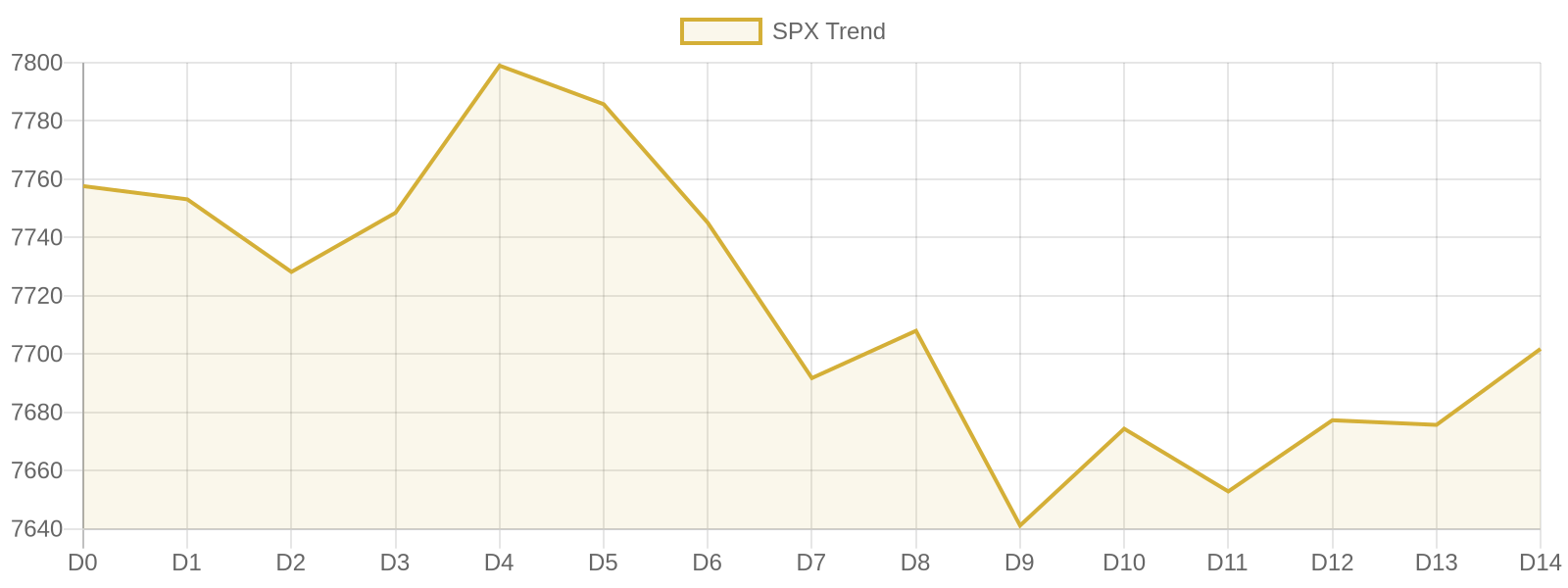
Executive Overview: High Equity Valuations Amid Sovereign Debt Expansion
As of August 27, 2026, global financial markets exhibit a compelling duality: sustained equity momentum paired with elevated sovereign borrowing costs and historic institutional demand for hard assets. Domestic equities continue their upward trajectory with the S&P 500 Index trading at 7,701.78, accompanied by a subdued CBOE Volatility Index (VIX) reading of 14.88. Concurrently, the benchmark 10-Year U.S. Treasury yield remains firm at 4.66%, driven by persistent term premia and sovereign debt supply dynamics.
Key Market Snapshot
- S&P 500 Index (SPX): 7,701.78
- CBOE Volatility Index (VIX): 14.88
- 10-Year U.S. Treasury Yield (USGG10YR): 4.66%
- EUR/USD Exchange Rate: 1.17
- Gold (XAU/USD): $4,631.40 / oz
- Bitcoin (BTC/USD): $79,534.57
Macro Narrative: Liquidity Operations, Fiscal Realities, and Hard Asset Demand
The central macroeconomic catalyst shaping financial markets in 2026 is the rapid expansion of U.S. national debt, which has now crossed $40 trillion. In response to structural supply absorption challenges across the long end of the yield curve, the U.S. Department of the Treasury has doubled its liquidity-support buyback operations for longer-dated nominal securities (specifically the 10-to-30 year sector) from $2 billion to $4 billion per operation.
While these Treasury interventions aim to bolster long-end market liquidity, the 10-Year yield holding at 4.66% highlights systemic investor concerns surrounding sticky inflation inputs—such as energy costs—and resilient underlying macroeconomic growth. Elevated yields reflect a higher structural cost of capital that cannot be erased by liquidity management alone.
Simultaneously, corporate earnings outperformance—led by technology, healthcare, and infrastructure/power generation—anchors equity market strength at 7,701.78. Yet, institutional market participants are taking a sophisticated dual approach. Spot gold trading near historic highs at $4,631.40 per ounce underscores ongoing reserve diversification by global central banks seeking security outside paper debt obligations. Digital assets and foreign exchange remain in relative equilibrium, with Bitcoin at $79,534.57 and EUR/USD at 1.17, demonstrating steady dollar liquidity conditions as institutional capital balances attractive bond yields against long-term macro hedging strategies.
Aquinas View: Distinguishing Economic Substance from Nominal Accidents
From the Aristotelian-Thomistic perspective of Catholic Realism, financial indicators represent nominal accidents rather than economic substance. An equity benchmark at 7,701.78 or expanded Treasury buybacks describe monetary velocity and liquidity arrangements. However, authentic wealth resides in real, productive capacities—human intellect, technological productivity, energy infrastructure, and tangible resources ordered toward the genuine human good.
When national debt exceeds $40 trillion, the financial architecture risks borrowing against future productivity to fund present liquidity. Debt expansion without corresponding physical and moral productivity creates a distortion where nominal paper assets appreciate while real purchasing power is quietly diluted. Gold at $4,631.40/oz is not merely a hedge against inflation; it is a rational market acknowledgment of enduring substance over contractual promises.
Investors must guard against the subtle temptation to conflate paper asset inflation with genuine value creation. Sound financial stewardship requires examining whether capital is actively directed toward productive, morally upright enterprise or merely riding the wave of monetary intervention.
Value Proposition: Signal Above the Noise
Navigating the financial landscape of 2026 requires far more than chasing momentum or reacting to daily headlines. In this noise, Aquinas Intelligence provides the signal. By combining rigorous quantitative metrics, macroeconomic scrutiny, and an unyielding foundation in philosophical realism, our methodology empowers institutional leaders to separate transient market chatter from authentic capital creation.
Strategic Conclusion & Call to Action
Today’s market structure offers substantial opportunity for those who look beyond surface calm to evaluate real underlying drivers. Capital allocation decisions made in 2026 will define institutional resilience for years to come.
To gain deeper analytical clarity and elevate your allocation strategy, Upgrade to Aquinas Intelligence today.