The Architecture of Sanctified Capital
A Doctrinal and Operational Manifesto
I. The Preamble: The Unity of Vision
We reject the modern dualism that severs the economic engine from the moral law. We affirm the opening truth of St. John Paul II:
“Faith and reason are like two wings on which the human spirit rises to the contemplation of truth; and God has placed in the human heart a desire to know the truth—in a word, to know himself—so that, by knowing and loving God, men and women may also come to the fullness of truth about themselves.” (St. John Paul II, Fides et Ratio, Opening Blessing)
In the domain of capital, this is not a metaphor; it is an operational imperative. Reason (Ratio) analyzes the material and efficient causes of a business (balance sheets, cash flows). Faith (Fides) illuminates the formal and final causes (the nature of the business and its ultimate end). To invest with only one wing is to fly in circles, inevitably crashing into the ground of unintended consequences. We posit that Right Reason (Recta Ratio) and Divine Law are not opposing forces. They are the unified standard of Reality.
II. The Diagnosis: The Error of Passive Complicity
The standard approach to capital allocation—the “market-neutral” index (e.g., S&P 500)— is a theological fallacy. It presumes that capital can be neutral. But St. Thomas Aquinas teaches that no human action proceeding from deliberate will is morally indifferent (Summa Theologiae, I-II, q. 18, a. 9).
By purchasing the index, the investor engages in material cooperation with the specific acts of the constituent companies. When those companies promote the destruction of life, the dissolution of the family, or the exploitation of the vulnerable, the passive investor provides the liquidity that sustains these disorders. Benedict XVI warned us explicitly:
“...every economic decision has a moral consequence.”
(Benedict XVI, Caritas in Veritate, n. 37)
To claim “diversification” as an excuse for funding intrinsic evil is to sacrifice the Soul
for the sake of a reduced standard deviation. It is a failure of Prudence, which acts as the
“charioteer of the virtues” (ST II-II, q. 47).
III. The Method: The Ontological Veto
We introduce the Ontological Veto. This is not merely “screening out sin.” It is a recognition of the nature of evil. As St. Thomas defines, evil is privatio boni—a privation of the good that ought to be present (ST I, q. 48, a. 1). Evil is a lack of being; it is a structural defect.
• Fragility: A company that profits by addiction is structurally fragile; it relies on the slavery of its customer base.
• Suicide: A company that profits by sterility (abortion/contraception) is structurally suicidal; it destroys the future labor force and market demand upon which it depends.
Therefore, our exclusion of these entities is not only a moral duty but a superior Risk Management Strategy. We do not merely avoid “bad” companies; we avoid entities that are ontologically defective and at war with the natural order.
IV. The Proposition: Resilience Through Natural Law
Why is a portfolio aligned with Natural Law superior? Because the Natural Law is the “instruction manual” of human flourishing. Companies that align with this law—supporting family, dignity of work, and real value creation—are swimming with the current of Reality.
1. Stability: They do not fear the light of truth or regulatory correction.
2. Loyalty: They treat labor not as a mere cost but as a subject of dignity, following the priority of labor over capital (St. John Paul II, Laborem Exercens, n. 12). This creates loyalty and operational excellence.
3. Sustainability: They serve the Common Good, ensuring their license to operate is rooted in societal contribution, not extraction.
Virtue is not a tax on performance; Virtue (Virtus) literally means “Strength.”
V. The Goal: The Sanctification of the World
Finally, we reject the notion that finance is a “necessary evil.” We embrace the call to universal holiness. As St. Josemar.a Escriv. taught, we must sanctify our work, sanctify ourselves in our work, and sanctify others through our work. Investment is work. It is the stewardship of talents.
“The legitimate pursuit of profit does not conflict with the obligation to help the poor and to contribute to society... on the contrary, if the economic logic is used in a correct way, it can be an instrument of solidarity.” (Compendium of the Social Doctrine of the Church)
The Aquinas Specification is this: To deploy capital with the precision of a Thomist and the zeal of an Apostle. We seek returns not for the accumulation of power, but for the expansion of the Kingdom and the freedom of the family.
We do not buy the haystack. We buy the needle. And the needle is Truth.
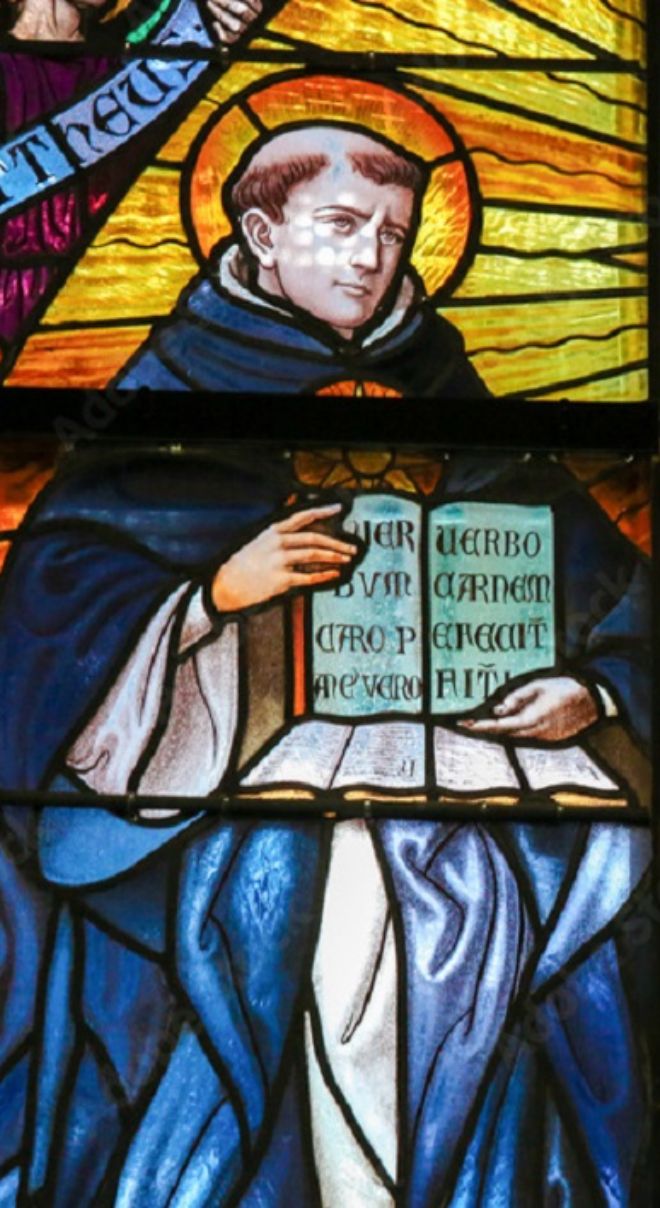
St. Thomas Aquinas
The Angelic Doctor and the Perennial Philosophy
St. Thomas Aquinas (13th century), the "Common Doctor" of the Church, is the foremost architect of the synthesis between reason and faith. His work demonstrates that reason can objectively know the order of being and nature, while faith—grounded in Divine Revelation—elevates and perfects the intellect with truths that surpass natural capacity without ever contradicting it. His method is rigorously disciplined: define, distinguish, address objections, and conclude in strict fidelity to reality.
1. A Realist Metaphysics At the core lies moderate realism: the world is intelligible and exists independently of our mind.
- The Person: A substantial unity of body and soul (hylomorphism).
- Morality: Not based on subjective feeling or utility, but on the truth about the human person and his ultimate end (telos).
- Virtue: It is not mere decoration or routine; it is a good operative habit (habitus) that stably orders human freedom toward the Good.
2. The Aristotelian–Thomistic Framework It is a philosophy of being. From Aristotle, Aquinas integrates key structures to explain reality:
- Act and Potency: Explains change and motion (what a thing is now vs. what it can become).
- The Four Causes: To understand anything, we must know its Material (what it is made of), Formal (what it is), Efficient (who made it), and Final cause (its purpose).
- Teleology: Every nature acts for an end; there is intrinsic meaning in the cosmos. Aquinas deepens this with the pivotal distinction between Essence (what a thing is) and Act of Being (esse—that it is). Creatures are not Being itself; they participate in Being, received from God.
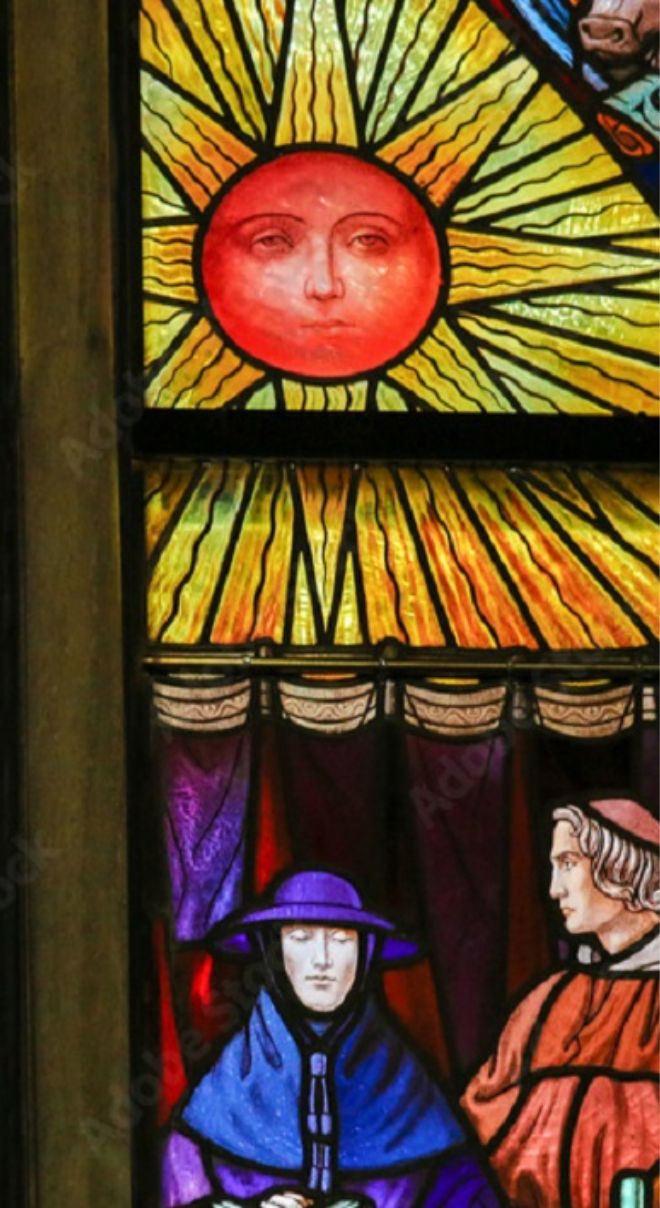
- Epistemology: Nihil est in intellectu quod non prius fuerit in sensu (Nothing is in the intellect that was not first in the senses). The mind draws universals from sensory experience; it does not "create" reality.
- Ethics & Natural Law: The human good is grounded in human nature. Reason recognizes the natural inclinations (to life, truth, society) and formulates the precepts of the Natural Law. Prudence (recta ratio agibilium) governs the means to achieve these ends.
3. The Potency of Thomism Its enduring power lies in its comprehensive scope:
- Speculative Unity: It integrates metaphysics, anthropology, and theology without internal contradiction. It refutes perennial errors such as reducing the good to mere utility, freedom to license, or truth to consensus.
- Practical Wisdom: It provides stable criteria for decision-making: proper ends, proportional means, the hierarchy of goods, and a sober realism regarding human limitations and the common good.
4. The Doctrinal Keystone: Faith and Reason The guiding principle is: "Grace does not destroy nature, but presupposes and perfects it."
- The Unity of Truth: Since God is the Author of both created nature (reason) and revealed truth (faith), there can be no genuine contradiction between them. Truth is one.
- The Ultimate Norm: While reason is a necessary instrument, Divine Revelation—safeguarded by the Magisterium—is the supreme rule, for the First Truth cannot deceive nor be deceived.
- Correction of Error: If a philosophical conclusion contradicts Revelation, it is a sign that reason has erred in its process, not that faith is irrational.