
Daily Market Briefing
Executive Summary & Macro Narrative (September 16, 2026)
As of Wednesday, September 16, 2026, global financial markets continue to navigate a delicate balance defined by persistent headline inflationary pressures, elevated benchmark Treasury yields, and highly concentrated technological resilience. Equity benchmark indexes display notable internal bifurcation, with the S&P 500 standing at 7,614.26 while broad volatility remains relatively subdued, as reflected by the VIX Index at 16.95.
Go Beyond the Briefing: The Pro Execution Strategy
This briefing provides the essential context. Our Pro Members receive the full operational layer: tactical moves and portfolio rebalancing driven by the Aquinas AI Engine. Move from information to execution capacity.
View Pro Strategy & Portfolios — 34% OFF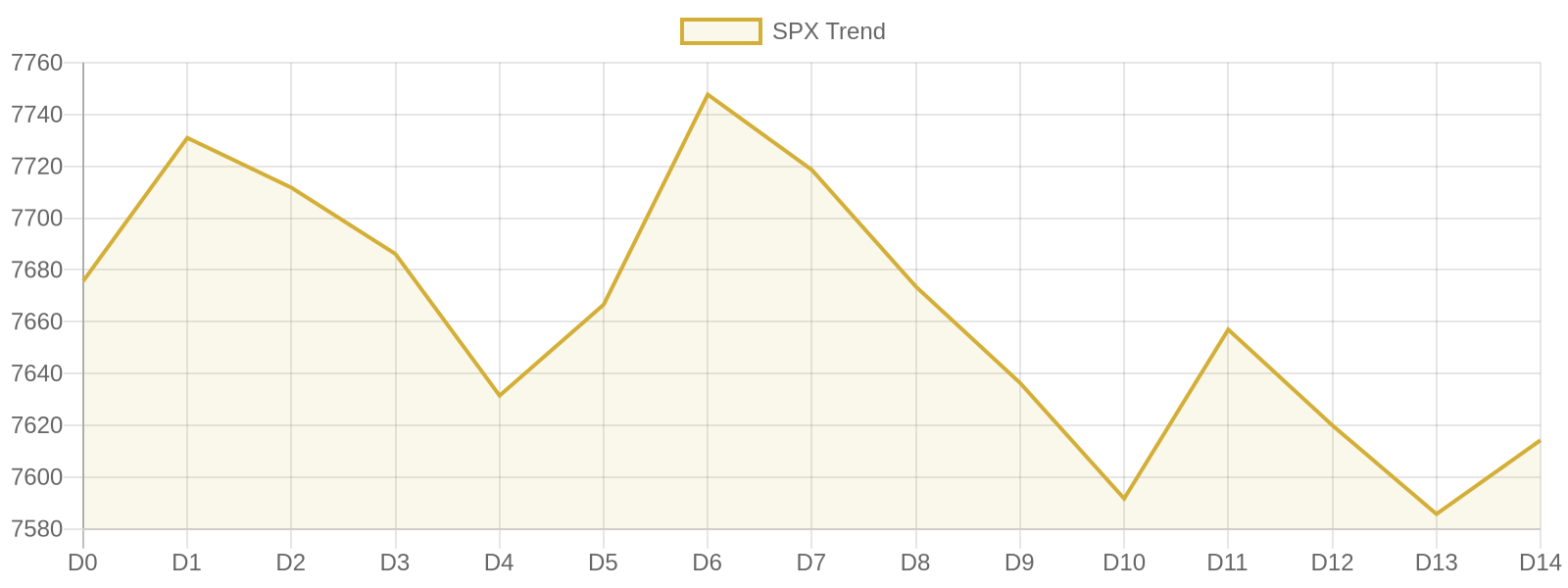
The dominant macroeconomic driver shaping global asset pricing remains Federal Open Market Committee (FOMC) interest rate policy expectations. Financial markets are currently pricing in high probabilities of a 25-basis-point rate hike at the upcoming Federal Reserve policy meeting. This hawkish repricing stems from resilient macroeconomic growth data combined with persistent inflation metrics, which remain fueled by global energy supply constraints and transportation frictions.
Most critically for capital allocation, the U.S. 10-Year Treasury yield is hovering near the crucial 5.00% structural benchmark—currently trading at 4.97%. Sustained cost-of-capital pressures at these levels present direct, formidable headwinds for interest-rate-sensitive and long-duration equities, creating significant pressure on utility providers and growth-oriented sectors. Simultaneously, persistent geopolitical conflicts and Middle East energy transit disruptions have kept crude oil prices elevated in the $100 to $105 per barrel range, reinforcing sticky inflation concerns across global economies.
Despite these tightening macro conditions, selective market strength in mega-cap artificial intelligence and technology leaders has cushioned headline equity benchmarks. In foreign exchange markets, the EUR/USD currency pair trades at 1.15. Concurrently, persistent geopolitical risks and inflationary headwinds continue to drive safe-haven demand, lifting Gold (XAU) to $4,384.90 per ounce, while Bitcoin (BTC/USD) trades at $75,545.08. While real-time market snapshots confirm asset levels, complete causal attribution across intraday asset fluctuations remains subject to evolving central bank policy statements and economic prints.
The Aquinas View: Aristotelian Realism Applied to Markets
From the perspective of Aristotelian-Thomistic realism, financial markets are not self-referential systems of pure speculation; they are secondary abstractions that must ultimately reflect primary economic realities and natural physical limits. Capital, by its true nature and teleology, is ordered toward productive enterprise, genuine utility, and authentic human flourishing. When financial pricing detaches from real productive causes, markets mistake temporary shadow for enduring substance.
The current market architecture showcases a clear dual behavior across asset classes. On one side, 10-year Treasury yields at 4.97% act as an objective, natural gravity on corporate balance sheets, raising discount rates and disciplining speculative capital misallocation. On the other side, the heavy concentration of market liquidity into cash-generative technology leaders and physical monetary assets like Gold ($4,384.90/oz) demonstrates a rational search by capital for balance sheet strength and unencumbered value preservation. Gold’s historic surge reflects a fundamental human intuition: when monetary debasement and geopolitical friction undermine abstract paper claims, capital seeks tangible, unencumbered anchors of value.
However, prudent investors must distinguish between genuine productive efficacy and speculative momentum. While select technology platforms generate verifiable productivity gains, market narrative alone cannot permanently negate fundamental discount rates. Investors who ignore cost-of-capital realities risk remaining overextended in vulnerable equities before inevitable market repricing forces asset valuations back into alignment with underlying economic constraints.
Value Proposition & Strategic Outlook
In an era saturated with technical noise, rapid narrative shifts, and persistent market volatility, intellectual clarity and moral realism become the paramount assets for institutional decision-makers. Conventional financial commentary often merely catalogues daily price action without uncovering the underlying structural causes driving economic reality.
In this noise, Aquinas Intelligence provides the signal.
By integrating rigorous quantitative financial analytics with classical philosophical principles, Aquinas Intelligence cuts through market consensus to deliver unvarnished structural clarity. We evaluate global asset classes not by transient market momentum, but by their alignment with objective reality, real capital preservation, and sustainable economic value.
To access our institutional intelligence suite, real-time macroeconomic assessments, and customized portfolio risk evaluations, we invite you to upgrade your subscription to Aquinas Intelligence. Ensure your capital allocation strategy remains firmly anchored in real economic causes, strategic foresight, and disciplined judgment throughout 2026 and beyond.