
Daily Market Briefing
Date: September 3, 2026
Author: Public Editor, Aquinas (Triuvo)
Go Beyond the Briefing: The Pro Execution Strategy
This briefing provides the essential context. Our Pro Members receive the full operational layer: tactical moves and portfolio rebalancing driven by the Aquinas AI Engine. Move from information to execution capacity.
View Pro Strategy & Portfolios — 34% OFFExecutive Summary & Market Snapshot
As of September 3, 2026, global financial markets navigate a complex macroeconomic environment characterized by geopolitical tension, persistent core inflation, and elevated risk-free benchmark rates. Despite these macro headwinds, major equity indices demonstrate structural resilience, bolstered by massive capital expenditure in technology infrastructure and strong industrial activity.
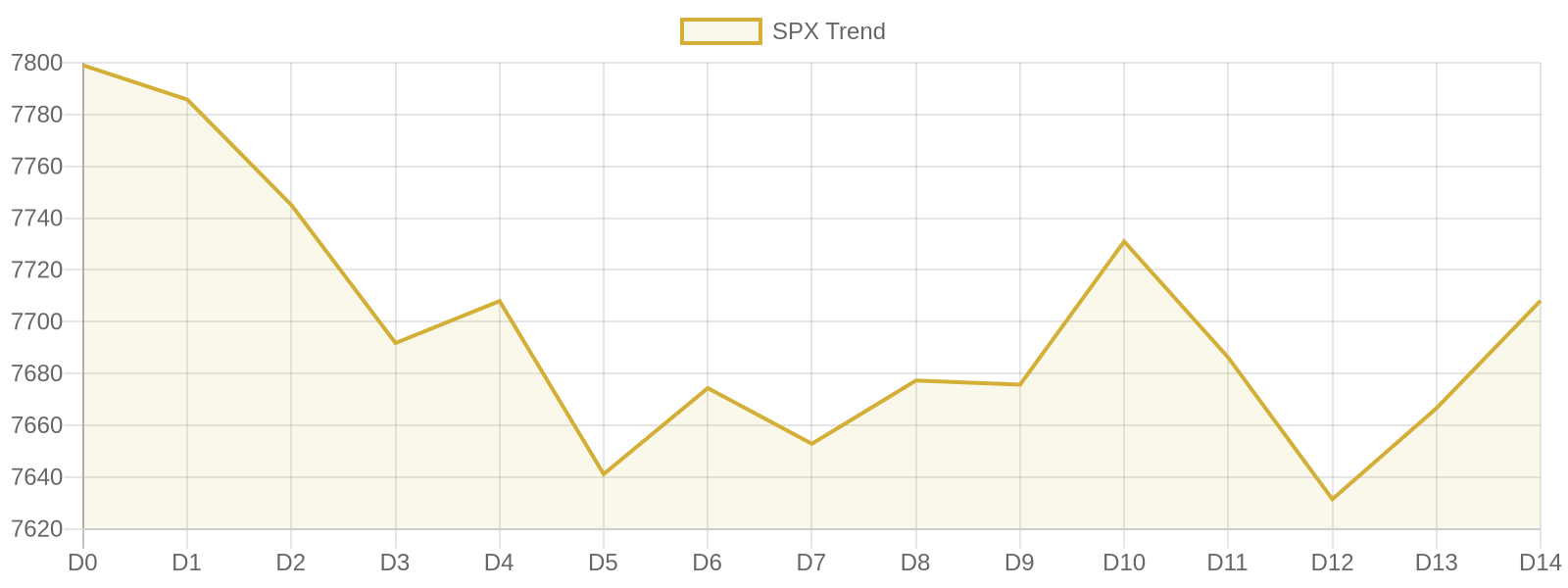
- S&P 500 Index (SPX): 7,708.12
- Cboe Volatility Index (VIX): 14.96
- US 10-Year Treasury Yield (USGG10YR): 4.75%
- EUR/USD (EURUSD): 1.16
- Gold Spot (XAU): $4,507.80 / oz
- Bitcoin (BTC/USD): $78,755.73
Macro Narrative: Geopolitics, Sticky Inflation, and Yield Dynamics
The primary driver of today’s financial landscape is a supply-side energy shock. Escalating geopolitical conflict in the Middle East and targeted strikes near critical strategic shipping corridors have driven sharp price increases across crude oil and refined products. This sudden surge in input costs has reignited broader market anxiety over persistent global inflation, complicating monetary policy trajectories across major economies.
In the United States, core Personal Consumption Expenditures (PCE) inflation remains elevated at approximately 3.3%. Hawkish communications from Federal Reserve officials have prompted institutional investors to recalibrate interest rate expectations, replacing near-term rate cut assumptions with potential further monetary tightening. Consequently, the US 10-Year Treasury yield holds firm around 4.75%. This elevated risk-free rate continues to compress yield spreads against equities, applying valuation discount pressure to high-multiplier growth sectors.
Yet equities remain remarkably durable. The S&P 500 index stands at 7,708.12, supported by massive ongoing capital commitments toward artificial intelligence, enterprise hardware, and resilient US manufacturing data. Institutional investors are aggressively scrutinizing corporate balance sheets, prioritizing cash-generative enterprises capable of absorbing higher borrowing costs.
Simultaneously, global capital flows reflect a dual flight to safety and liquidity. Gold trades near elevated territory at $4,507.80 per ounce as asset managers hedge against geopolitical volatility and currency erosion, despite the friction of high real yields. Concurrently, Bitcoin maintains a robust position at $78,755.73, signaling sustained institutional liquidity allocation toward digital scarcity amidst broader asset rebalancing.
The Aquinas View: Distinguishing Substance from Shadow
From the perspective of Aristotelian-Thomistic realism, financial markets represent an ongoing tension between substance (substantia) and secondary accidents (accidentia). Valuations frequently confuse speculative momentum with real, productive wealth. When inflation distorts economic calculation, money loses its proper order as a stable measure of value, introducing moral and structural confusion into economic exchange.
The current market environment tests whether corporate enterprise reflects genuine productive potency (actu) or leverage-fueled illusion. High discount rates—symbolized by the 4.75% 10-Year Treasury yield—act as a natural crucible, demanding that capital prove its intrinsic yield. Prudence (prudentia) dictates that capital allocation must be ordered toward businesses delivering real economic utility, durable balance sheets, and moral rectitude. Distinguishing sustainable earnings from inflated valuations is not merely an analytical preference; it is a foundational requirement of economic justice and prudent stewardship.
Value Proposition: Methodological Clarity Amid Market Noise
Modern financial media overwhelms market participants with fragmented data and transient noise. Investors who react solely to immediate price fluctuations risk mistaking temporary volatility for structural shifts.
In this noise, Aquinas Intelligence provides the signal.
Our analytical framework integrates empirical market data, precise causal economic modeling, and unyielding moral alignment. By evaluating financial assets through real-world operational substance and ethical integrity, we empower institutional allocators to look beyond superficial sentiment. We identify enduring competitive advantages, audit capital deployment against objective principles of truth, and protect portfolios against hidden systemic vulnerabilities.
Strategic Imperatives & Call to Action
As we navigate late 2026, market participants must maintain disciplined asset allocation. High-multiplier growth assets must be balanced against hard-asset inflation hedges and rigorous cash-flow audits. The era of cheap money has yielded to a regime defined by capital scarcity, geopolitical realignment, and real yield demands.
To explore how our deep analytical framework can optimize your institutional capital strategy in 2026, we invite you to review our premium intelligence solutions.