
Daily Market Briefing: September 1, 2026
Executive Overview: The Autumn Friction Sets In
As global markets cross the threshold into September 2026, the traditional seasonal caution known as the “September Effect” has asserted itself with immediate force. On this Tuesday, September 1, 2026, risk assets across international exchanges opened under pronounced pressure, driven by a sharp upward movement in benchmark sovereign bond yields, escalating energy cost anxieties, and renewed geopolitical friction in the Middle East.
Go Beyond the Briefing: The Pro Execution Strategy
This briefing provides the essential context. Our Pro Members receive the full operational layer: tactical moves and portfolio rebalancing driven by the Aquinas AI Engine. Move from information to execution capacity.
View Pro Strategy & Portfolios — 34% OFF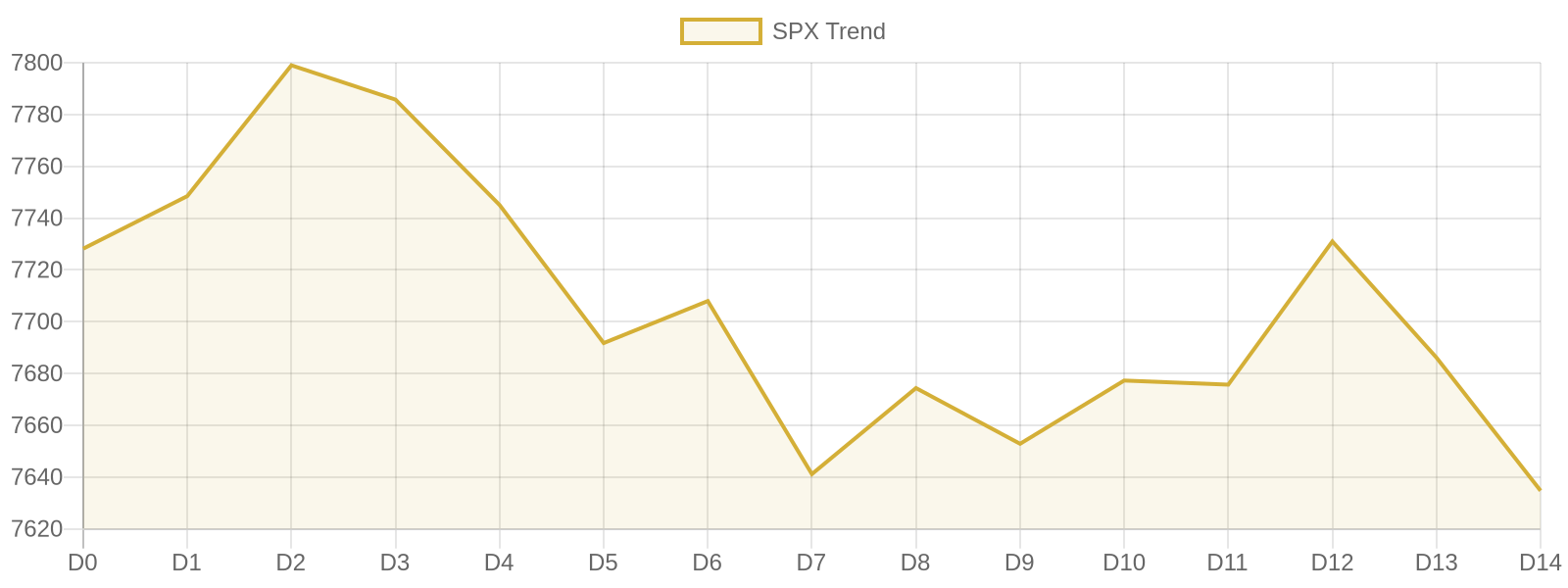
The S&P 500 Index (SPX) retreated -0.67% to close at 7,634.75, while the CBOE Volatility Index (VIX) jumped +5.97% to 15.82, marking a clear pivot toward defensive positioning. Fixed-income markets experienced an accelerated sell-off, pushing the US 10-Year Treasury Yield (USGG10YR) up to 4.78% and the 30-Year Treasury Yield to 5.27%. In foreign exchange, EUR/USD held at 1.16, while spot Gold (XAU) recorded the day’s most significant retreat, falling -1.76% to $4,406.40 per ounce under the weight of surging real interest rates and US dollar resilience. Bitcoin (BTC/USD) traded at $78,090.00, navigating the broader cross-asset liquidity crunch.
Macro Narrative: Bond Yield Spikes and Geopolitical Energy Pressures
The primary catalyst behind today’s market pullback is the confluence of persistent inflationary pressures and structural fiscal realities. Long-duration fixed-income assets remain under severe strain as market participants re-evaluate the path of Federal Reserve monetary policy. With the benchmark 10-Year yield reaching multi-month highs near 4.78%, capital costs across corporate and sovereign debt structures are adjusting upward, constraining equity valuations.
Compounding these fixed-income headwinds is a sharp escalation in geopolitical risk. Military friction between the United States and Iran in the Middle East, combined with logistical threats in the Strait of Hormuz, has driven Brent crude oil past $92 per barrel. Higher energy input costs act as an immediate tax on global industrial productivity while rekindling core inflation risks that complicate central bank monetary easing. The drop in Gold to $4,406.40—despite its historical safe-haven role—reflects the immediate opportunity cost imposed by high nominal yields and real interest rates, proving that even hard assets are subject to short-term liquidity realignments.
The Aquinas View: Distinguishing Substance from Accidents
From the perspective of classical Aristotelian-Thomistic realism, financial market turbulence often stems from a fundamental confusion between substance (the essential, enduring reality of productive assets) and accidents (the fleeting, secondary phenomena of daily price fluctuation and market sentiment).
In times of seasonal anxiety, market participants frequently allow accidental noise—such as short-term headline spikes, emotional momentum, or speculative panic—to obscure underlying economic truth. True financial stewardship and institutional prudence (prudentia) demand that we evaluate capital allocation not through the lens of transient passions, but through the rigorous analysis of final causality, intrinsic value, and structural integrity. Rising yields and geopolitical shocks are real temporal friction points, yet they must be measured against the genuine productive capability and moral order of the underlying enterprises.
The Value Proposition: Signal Above the Noise
Navigating the financial landscape of 2026 requires an intellectual anchor capable of separating structural truth from market emotion. While consensus commentary often vacillates between uncritical exuberance and paralyzing fear, our analytical framework applies first principles, rigorous empirical verification, and teleological clarity to every asset class.
In this noise, Aquinas Intelligence provides the signal.
By integrating rigorous quantitative metrics with immutable metaphysical principles, we enable institutional investors and discerning leaders to discern authentic value, anticipate structural shifts, and maintain strategic composure when short-term volatility destabilizes the broader consensus.
Strategic Horizon & Call to Action
As high debt servicing costs and geopolitical energy bottlenecks test market resilience throughout late 2026, passive observation is no longer a viable strategy for capital preservation. Discerning investors must actively re-align their portfolios toward resilient balance sheets, unencumbered real goods, and genuine productive capacity. Opportunity belongs to those who act with clarity before market momentum shifts again.
To gain full access to our deep-dive institutional analysis, bespoke asset auditing, and real-time risk assessments: